
Lynbrook Resident Lookup Record Coverage
A one-person record check is not a complete public roll of everyone who lives in the village. The Nassau Land Records Viewer can connect a parcel with an owner or taxpayer and a mailing address. New York’s voter form can corroborate a known person and address. Court and probate indexes can add a case or estate connection, while vital indexes and local-history collections help with older family questions. Start with the source that matches the fact already known, then preserve the date and result identifier.
| Record | What It Confirms | Where | Access |
|---|---|---|---|
| Assessment roll | Owner or taxpayer, situs address, mailing address and SBL | Nassau Land Records Viewer | Free online lookup; owner is not automatically the occupant |
| Recorded deed | Legal parties, recording date and parcel description | Nassau County Clerk land index | Electronic records from July 1992; earlier media and counter access reach back to 1899 |
| Voter status | Known registrant, poll-site and address match | NYS voter lookup | Individual form; statewide data has election-purpose limits |
| Court or probate index | Party role, court, case or file number, dates and status | NYS eCourts and WebSurrogate | Public metadata varies; restricted files remain unavailable |
| Vital index | Older birth, death or marriage event details | NYS Archives and DOH | Microfiche/index route; certificate eligibility is narrower |
| License or entity record | Professional or business affiliation | NYS licensing and DOS records | Useful as a second identifier, not proof of residence |
For a current property question, use the parcel and its Section, Block and Lot, or SBL, before testing a name in other indexes. For a family-history question, a date of death, a spouse name, or a former street address may point first to probate, a newspaper, or a state vital-index route. The same surname alone is rarely enough in Lynbrook’s dense, compact village.
Lynbrook Residents Need Two Identifiers
Use an exact name plus a second fact before treating two records as the same person. A middle initial, approximate date of birth, spouse, parcel, case number, or dated public affiliation can separate similar names. Try surname-first order, initials, former surnames, and O’/Mc punctuation variations. New York’s professional-verification guidance specifically warns that punctuation can change a result, and the same caution helps when deeds or old directories index a legal name rather than a familiar one.
Compare the kind of address before comparing the text. The assessment record has a situs address, meaning the physical parcel, and may show a tax mailing address elsewhere. A deed’s return address is a transaction contact. The voter-file layout separately identifies a residence address and a mailing address. Those differences can support a careful timeline, but they do not establish that a person currently lives at any one address.
Note: Record the search date, spelling used, custodian, and a parcel, file, or case number so a later check can be repeated accurately.
Lynbrook Voter Status for One Person
The New York voter lookup is an individual status and poll-site form, not a public directory by neighborhood. It asks for county, last name, first name, date of birth, address information, and ZIP. Use Nassau County and the person’s known address details. A non-match may reflect a changed legal name, a move, an inactive status, a protected registration, or a simple form mismatch. It does not prove that someone was never registered.
The state voter-status form illustrates why a documented check needs more than a name.
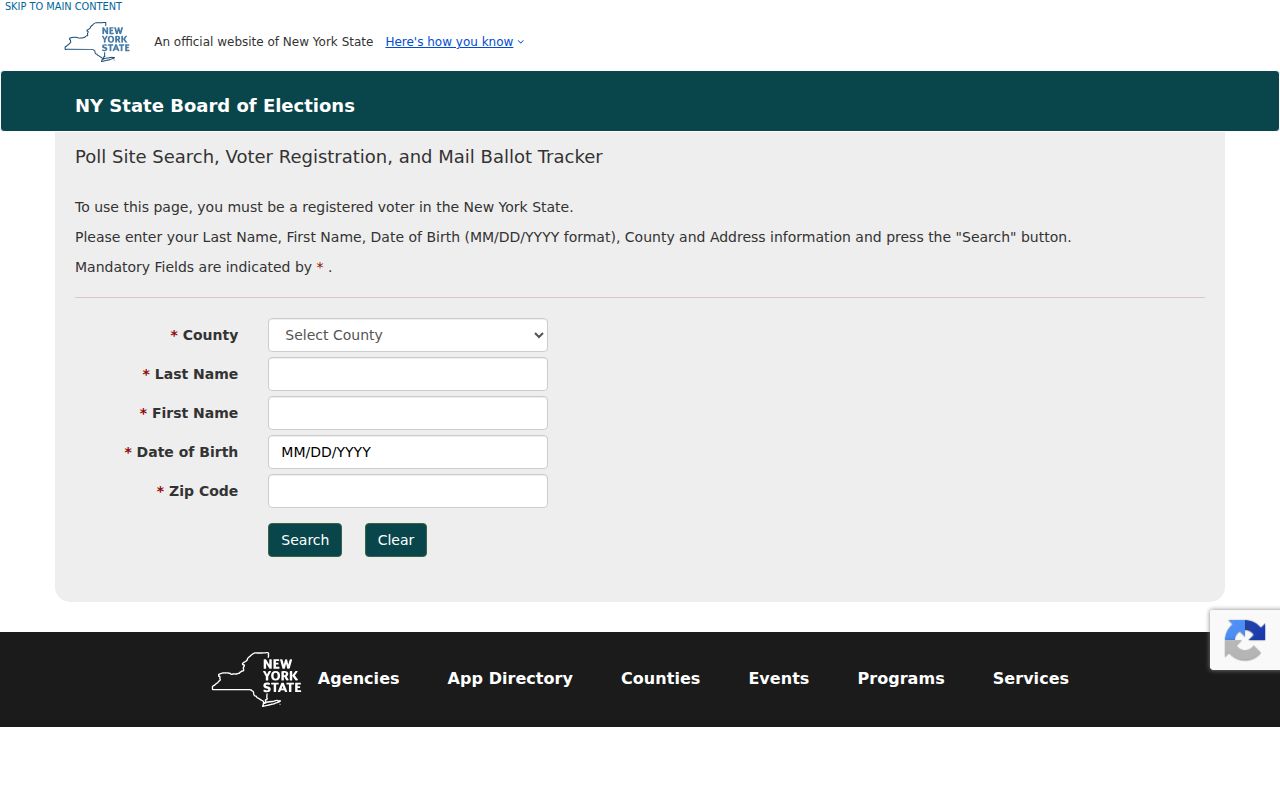
The visible county, name, date-of-birth, address, and ZIP fields support a narrow confirmation check. New York Election Law § 3-103(5) limits statewide voter-list data to elections purposes, and confidential registrations under Election Law § 5-508 are not available for ordinary inspection.
Lynbrook Court Records by Name
Nassau District Court is available through WebCivil Local, and Nassau Supreme cases can be searched through WebCivil Supreme. A party-name search is one route, but the court screens also offer attorney, judge, court, filing-year, case-status, and future-appearance controls. WebCriminal requires first and last name entries or a qualifying corporation name. Court indexes identify proceedings, not conclusions about a person, and sealed, juvenile, matrimonial, adoption, Article 81, and other protected matters may not appear.
The WebCivil Local party-search interface shows the available case filters for a Lynbrook name search.
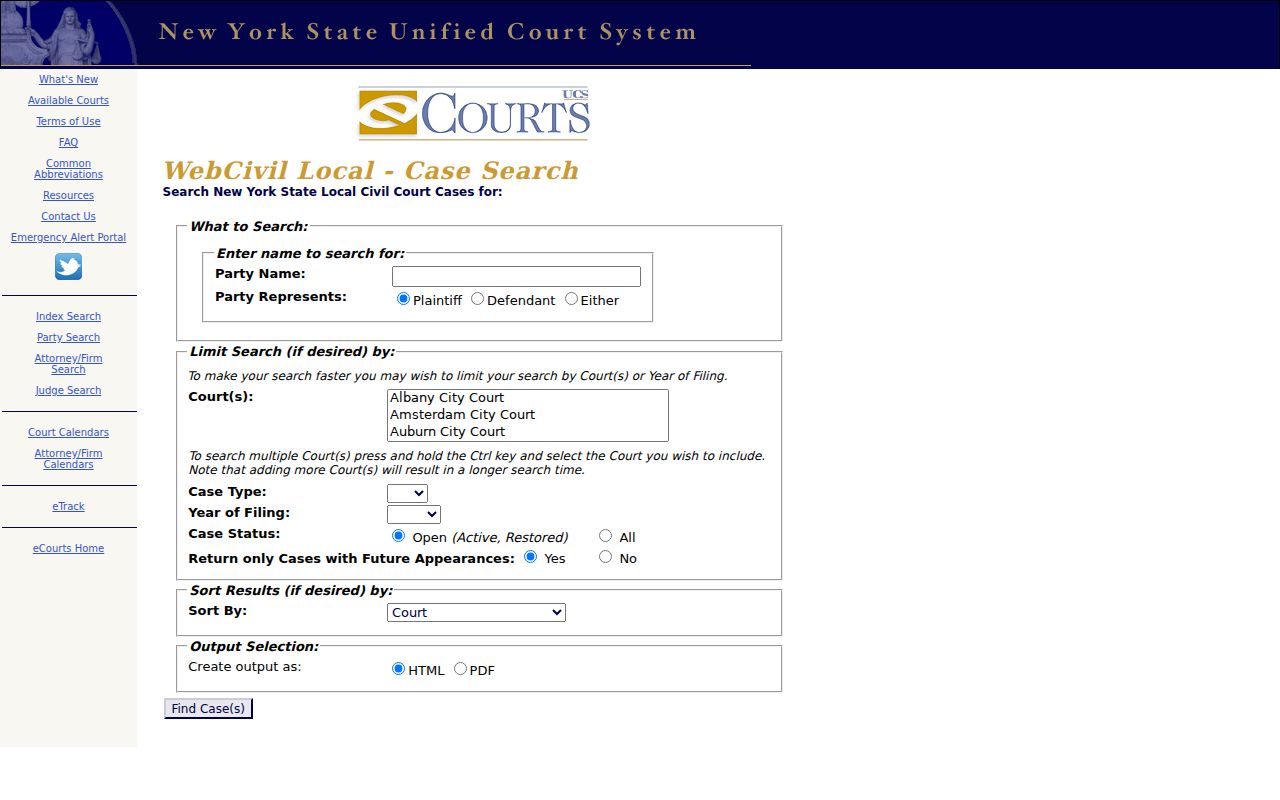
Capture the court, index or case number, party role, filing year, case type, and status when a result appears. Those fields make a clerk request or a later search more precise. A local Village Justice Court web name-search portal was not located, so its clerk is the documented route for local docket or file questions.
| Result field | Why it matters |
|---|---|
| Party name and role | Distinguishes plaintiff, defendant, petitioner, or respondent. |
| Index or case number | Supplies the unique retrieval key for court staff or a document request. |
| Court and county | Separates Nassau District, Nassau Supreme, and another venue. |
| Filing date and status | Places the record in time and avoids reading an old filing as current. |
| Document access or restriction | Shows whether an image may be available, onsite-only, or protected. |
Verify a Lynbrook Resident Across Records
A strong one-person verification builds a dated chain instead of relying on a single hit. The order below starts with an address connection, then checks a court or state record only when it can answer a distinct question. Keep the full spelling used by each custodian. If the records point to different periods, do not force them into one current profile.
- Search the parcel in LRV by house number, street, Town of Hempstead, and ZIP, or use the SBL. Preserve the owner or taxpayer name, situs address, mailing address, and SBL exactly as shown.
- Use the Clerk’s deed index with the legal name and SBL. Confirm that the legal description matches the parcel before treating a deed party as connected to the address.
- For a known voter, run the individual state form with the exact name, date of birth, county, address, and ZIP. Treat it as a dated status check, not an occupancy list.
- Search the applicable court or probate index with name variants. Record the case or file number, court, date, role, and status before requesting a copy from the custodian.
Some terms make the record trail easier to read:
- Docket
- A court’s running case record, usually listing filings, appearances, events, and status rather than every document image.
- Index
- A searchable list of record entries and identifying fields. It can point to a file without providing the underlying document.
- Image
- A scanned view of a document. Availability can differ by court, filing date, privacy rule, or whether the file must be viewed onsite.
- Certified copy
- A custodian-issued copy bearing the certification required for official use; eligibility, fee, and format depend on the record type.
Lynbrook Resident Vital Indexes
For older records, the NYS Department of Health genealogy route and the State Archives index are distinct channels. Archives microfiche indexes are not an online certificate collection. They cover births from 1881 through 1937, marriages from 1881 through 1960, and deaths from 1880 through 1960. Index entries can supply a name, event date or place, and certificate number, while a copy request follows the custodian’s eligibility rules.
The New York genealogy application guidance explains the age and proof requirements for a historical Lynbrook record search.
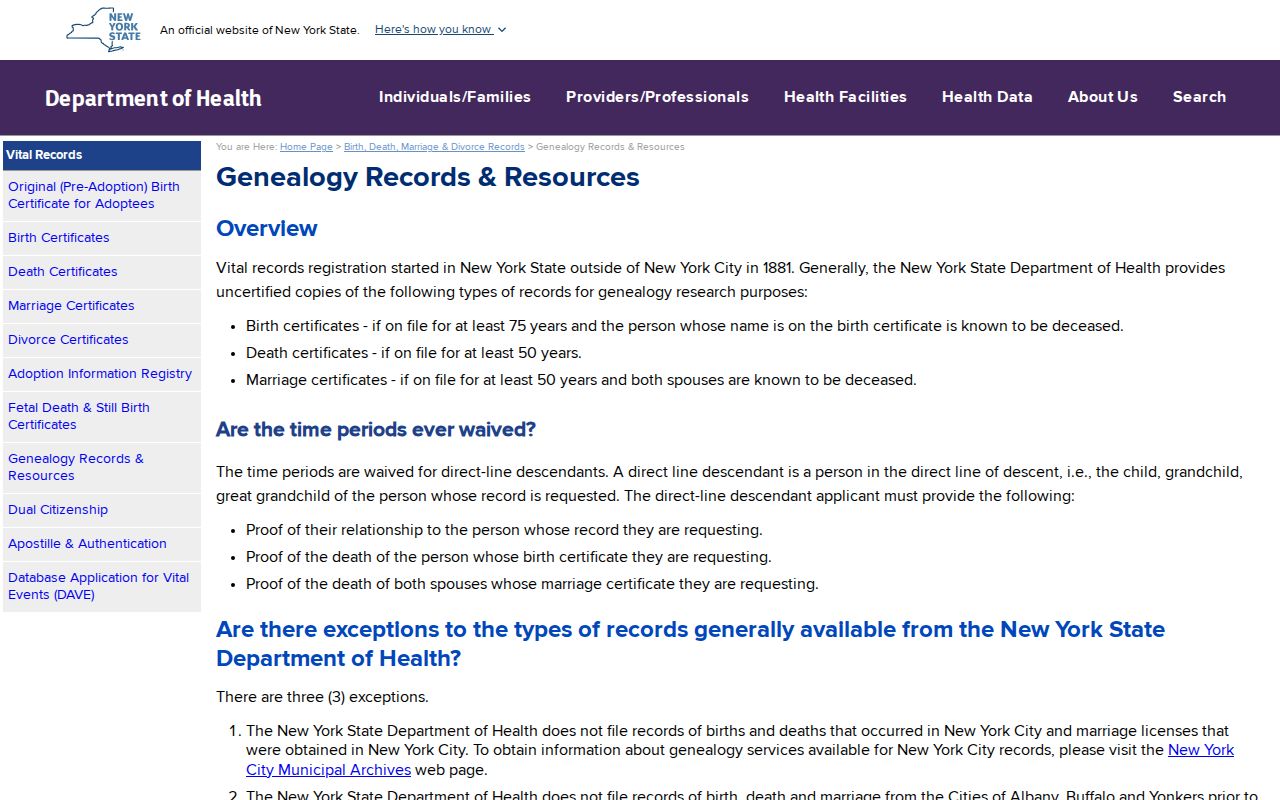
Genealogy copies are uncertified. A birth record must be at least 75 years old and the person known deceased; a death record must be at least 50 years old; and a marriage record must be at least 50 years old with both spouses known deceased. Direct-line descendants can request a waiver with relationship and death proof. The DOH form uses mail payment by check or money order, and processing may take eight months or longer.
For a Lynbrook birth or death event, the Village registrar is a local starting point. Marriage licenses are held by the town or city clerk that issued the license, not by the village. Divorce case details are held through the court or County Clerk path, while the state offers a separate dissolution-certificate route.
Note: State Archives microfiche is not online, so confirm reader access before traveling and separate index discovery from a copy request.
Lynbrook Resident Probate Clues
WebSurrogate can be useful when a family is tracing an estate, heir, or property connection. Its name search can be narrowed by date of death, and its file, old-index, index-book, and will-search modes answer different questions. A probate index may identify a decedent, fiduciary, estate number, or related address in a filing. It does not establish a current address for every named person.
Nassau makes outside-courthouse document links available for filings on or after February 19, 2014. Earlier unrestricted documents may require the public computers at the Nassau Surrogate’s Court. Safekeeping wills and adoption proceedings are not public name-search material. This online and onsite split is an important local access detail when an estate record stops at metadata.
Business entities, license results, and unclaimed-funds records can also serve as second identifiers. A service-of-process address, license location, or prior address is a dated association, not proof that the person lives there now. Match it to a parcel, time period, or another official record before relying on it.
When Lynbrook Records Do Not Match
A missing result often identifies an access limit rather than a dead end. Court items can be sealed or not yet entered. Voter status can be inactive, confidential, or tied to a prior name or address. Vital records may fall outside the released index years, and the local library does not publish a complete obituary-index run. For a narrow government record, use the actual custodian and describe the name, date range, record type, address or SBL, and preferred electronic format in a FOIL request.
New York’s Freedom of Information Law, Public Officers Law Article 6, directs an agency to grant, deny, or acknowledge a request within five business days and provide an approximate date when more time is needed. The Village’s 2025 scanning and inactive-records work also means a request may lead to a scanned file, a retention response, or a redaction review instead of an online search result. Ask for the particular series and date range rather than assuming a broad name search exists.
Note: A no-record response should be kept with the exact request and date, because it may reflect spelling, coverage, privacy, or indexing limits.
Lynbrook Resident Record Privacy
New York protects some information even when related records are generally public. The Address Confidentiality Program provides an eligible participant with a substitute legal mailing address, while the actual location remains confidential. Confidential voter registrations are separated from ordinary inspection, and DMV personal information is restricted. Court files can also protect sealed, matrimonial, juvenile, adoption, and confidential personal information. Do not try to combine partial facts to reveal a protected address.
Lawful use. Use these records for personal, lawful research such as family history, reconnecting with a known person, estate work, or checking an official record. Using information to stalk, harass, intimidate, or harm anyone may violate New York law.
If an official result appears wrong, preserve its date and identifier and contact the custodian that created it. The assessment office, County Clerk, Board of Elections, DOH or local registrar, court clerk, and licensing agency each control different correction paths.