
Start a Lynbrook Residents Directory Search
A Lynbrook residents directory search works best when the record matches the question. An address points first to Nassau assessment data and its parcel identifier. A full name may lead to a recorded deed, a court index, an individual voter-status check, or a historical directory. Each source has a date and a purpose. The assessment roll names an owner or taxpayer, not every person at an address. A deed proves a recorded transaction, not continuous residence. Keeping those limits in view prevents a plausible name match from becoming a wrong identification.
For current records, compare a parcel result with the deed index and, when the lawful individualized fields are known, voter status. For older people or homes, add a directory reel, newspaper item, map, probate file, or village archive record. The most reliable answer normally has two independent keys, such as a name and SBL, an address and a dated document, or a name plus a court file number.
- Search the address in the Nassau Land Records Viewer and write down the situs address, owner or taxpayer name, mailing address, and Section, Block, and Lot.
- Use the same legal name or SBL in the Nassau County Clerk land-record index to identify a dated deed, mortgage, lien, or map filing.
- Use the New York voter-status form only to check an individual registration with the requested name, date of birth, county, address, and ZIP.
- For a past household, consult the verified 1928/29 Lynbrook directory reel and the library or historical-society collections.
- When a database stops, ask the actual custodian for the defined record series, date range, address, SBL, or index number, including a FOIL request where appropriate.
Lynbrook Record Keepers for Residents
Three custodians supply most current Lynbrook resident evidence. The Nassau County Department of Assessment maintains the roll and parcel data. The Nassau County Clerk records land instruments and keeps the related index. The New York State Board of Elections provides an individualized voter-status service, while Nassau handles county election records and FOIL forms. Village offices matter when the trail reaches a permit, local archive, village election, or vital event that occurred within the village.
Nassau Assessment Department
240 Old Country Road, 4th Floor
Mineola, NY 11501
(516) 571-1500
Nassau Board of Elections
240 Old Country Road, 5th Floor
Mineola, NY 11501
(516) 571-VOTE
Lynbrook Parcel Search Fields
The Nassau Land Records Viewer is the practical starting point for a Lynbrook address. It connects the address to assessment-roll data, tax maps, property photographs, taxes, exemptions, and sales context. Enter the house number and street name, then add town or ZIP if needed. Nassau tells users to omit a direction and a street suffix, so a search should use the core street name rather than a guessed postal format. If an address search fails, use only the first few letters or move to Section, Block, and Lot, commonly called SBL.
The Nassau Land Records Viewer shows the address and SBL search route used for Lynbrook parcels.
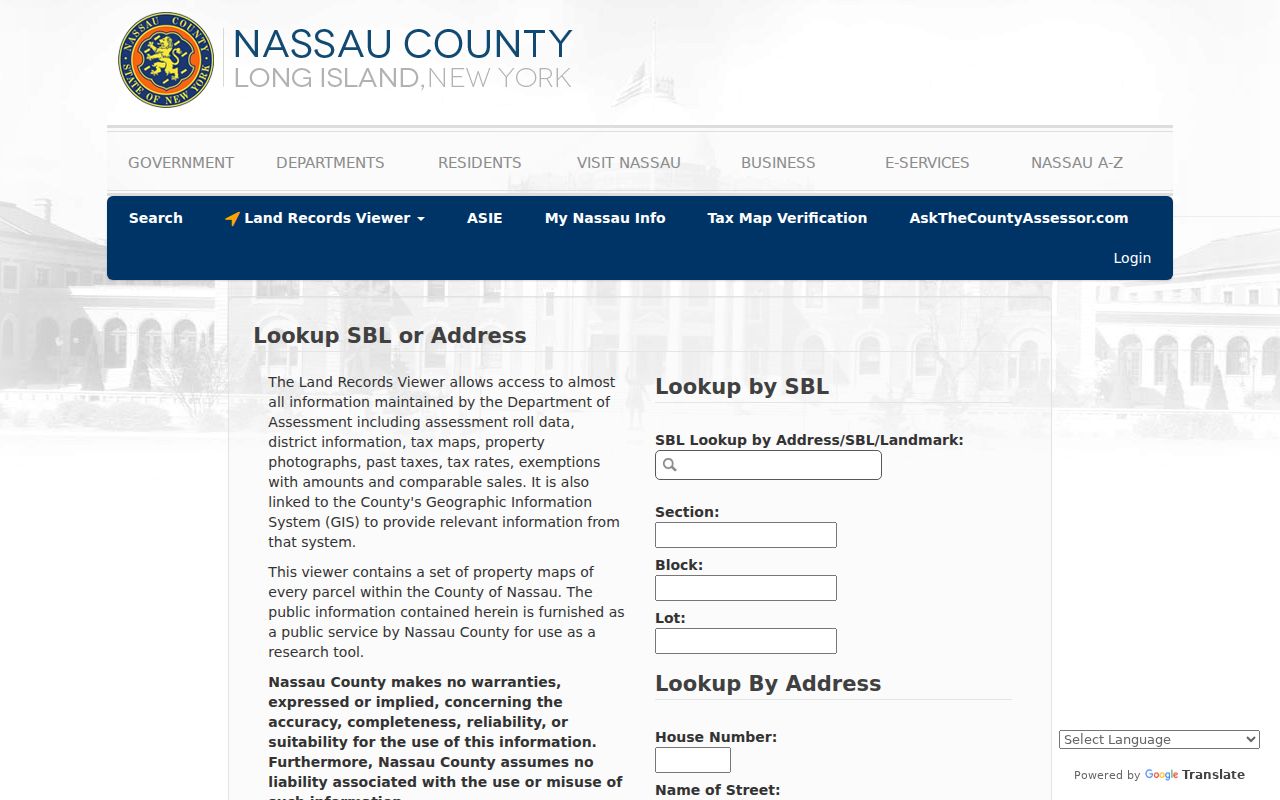
That screen is useful for anchoring a name to a specific parcel before moving into the recorded land index.
| Viewer field | Use for a Lynbrook search | Search note |
|---|---|---|
| House Number | Starts an address search | Pair it with the core street name. |
| Name of Street | Finds parcel candidates | Leave out direction and suffix. |
| Town or ZIP | Narrows a common street | Use the postal context shown by the record. |
| Section, Block, Lot | Links assessment and deed research | Copy it exactly and check Clerk formatting. |
Note: The viewer is a research aid, and the County Clerk record controls when an SBL or legal-description detail conflicts.
Lynbrook Owner and Mailing Details
A parcel has more than one address-like field. The situs address is the physical property. The tax mailing address is where a tax bill can be sent. The owner or taxpayer may be an individual, a trust, estate, corporation, or someone who lives elsewhere. Treat each as a dated record clue, not as a list of all occupants. This distinction is especially important in a compact village, where common names and close street names create easy false matches.
- Parcel
- A defined piece of land shown in the assessment and map systems.
- SBL
- Section, Block, and Lot, the local identifier that ties a parcel to land records.
- Situs address
- The physical location of the parcel, which can differ from a tax mailing address.
- Index
- A finder record that points to a filing; it is not necessarily the full document image.
For a whole-road research task, use the address and parcel sequence first. The detailed parcel-and-deed workflow is kept with the Lynbrook by-street directory, where the address chain is treated parcel by parcel.
New York Voter Status in Lynbrook
New York’s voter-status form is an individual confirmation tool, not a public Lynbrook street roster. It asks for county, last name, first name, date of birth, address information, and ZIP, then helps a registered voter locate status, poll-site, or mail-ballot information. A no-match can reflect a changed name or address, inactive status, a protected registration, or an entry error. It is not proof that someone never lived in Lynbrook.
New York’s voter-status lookup illustrates the individualized fields required for a lawful confirmation.
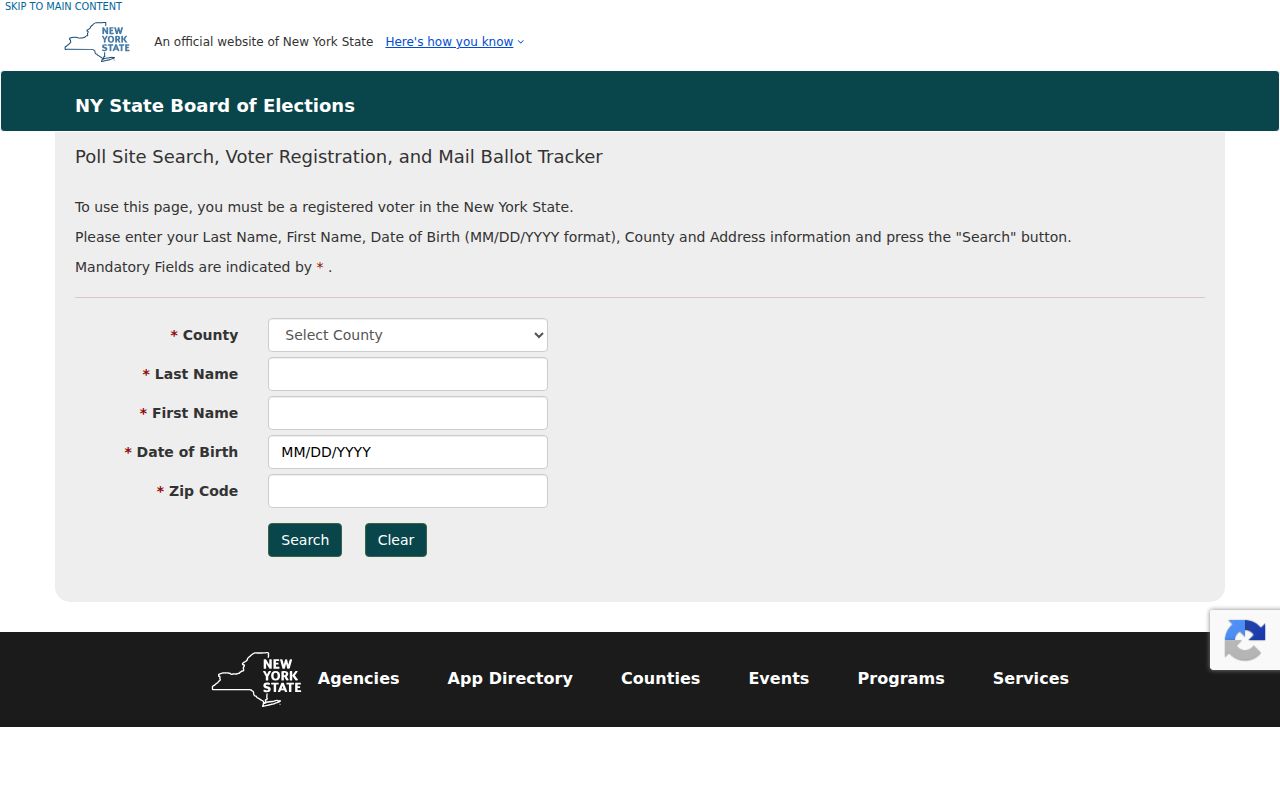
The fields make clear why this service does not function as a broad resident list for a street or ZIP.
Election Law § 3-103(5) restricts statewide-list information to election purposes. Nassau or State Board requests have their own forms and conditions. New York also separates confidential voter registrations under Election Law § 5-508, and ACP participants may use the state’s address-confidentiality process. Those protections are valid reasons that a public record search may not reveal a person.
Current Lynbrook Resident Directories
No official master list identifies every current Lynbrook household. The records below are the closest directory-like sources, but each answers a narrower question. Use the keeper and date to judge the result. Owner evidence, a voter-status match, and a recorded party name are different forms of evidence and should never be silently merged.
| Source | Who It Lists | Keeper | Access |
|---|---|---|---|
| Assessment roll and parcel record | Owner or taxpayer connection | Nassau Assessment | Online viewer and office |
| Individual voter status | Registered voter status and poll information | New York and Nassau elections offices | Individual form; list access restricted |
| Recorded land index | Parties to deeds, mortgages, liens, maps | Nassau County Clerk | Electronic index; older media onsite |
| Village archive and permits | Appointments, notices, address-linked filings | Lynbrook Village Clerk or Building Department | Request, counter, or FOIL route |
| Local-history collections | Names in directories, programs, photos, and news | Lynbrook Library and Historical Society | Onsite and collection-specific access |
For one named person, compare the precise record types rather than searching broadly. A dated deed or court entry, a voter-status confirmation, and a historical item can each help with a different part of the question. The Lynbrook resident lookup route focuses on that person-by-person verification.
Lynbrook Deed Names After 1992
Nassau’s land registry begins with the county’s 1899 charter, but its electronic land-record database begins in July 1992. That is a digital cutover, not the start of ownership records. A current Lynbrook parcel can lead to a grantor, the person transferring an interest, and a grantee, the person receiving it. Capture the instrument number, recording date, parties, document type, book and page or image key, SBL, and legal description. Then compare the legal description with the parcel instead of relying on the street address alone.
Records before the electronic period remain available through public computers, index books, property cards, liber books, microfilm, microfiche, county maps, and Records Center requests. The Clerk does not give ownership information by telephone or email. Bring the address, SBL, names, date range, and document type to the counter or use the index first. The County’s free property-fraud alert can also send email when a selected name or property description appears in a later filing.
Note: A recorded deed identifies a transaction and its parties, but it does not prove that a grantee occupied the property without interruption.
Lynbrook Court and Probate Name Records
When a parcel or name needs another dated source, the New York Unified Court System provides separate indexes for local civil cases, Supreme Court cases, criminal matters, Family Court, and Surrogate’s Court. WebCivil Local covers Nassau District Court; WebCivil Supreme covers Nassau Supreme Court. A party-name result can show a court connection, case type, filing year, status, role, or appearance. It does not decide the facts of a case or establish a current address.
WebCivil Local is the Nassau civil-party search interface captured for this Lynbrook residents directory.
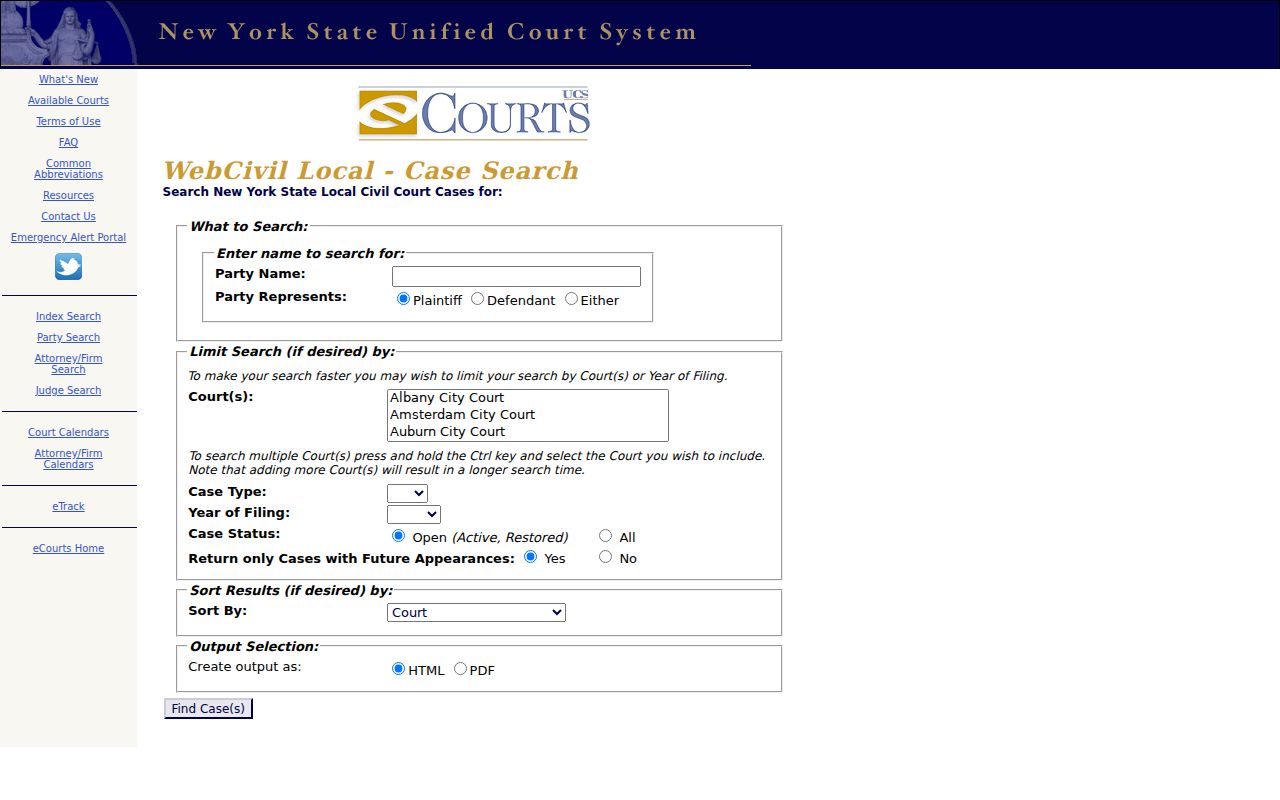
The court, type, year, status, and party-role controls help distinguish one same-name result from another.
For estates, WebSurrogate has name, file, old-index, index-book, and will-search routes. Nassau’s online image links are limited to filings on or after February 19, 2014. Earlier unrestricted documents are viewed on courthouse public computers, and adoption or safeguarded-will records have tighter limits. A docket is the court’s list of filings and events, while the file or image is the underlying document.
Lynbrook Vital Records by Event Date
Lynbrook’s registrar records births and deaths that occurred within the village, but no public online village name index was located. Call the Village Clerk or registrar to ask which custodian currently holds a defined local event and what eligibility applies. Statewide records outside New York City are also handled by the New York State Department of Health, while the State Archives supplies historical index and microfiche research channels.
New York genealogy copies have age-and-death rules: birth records must be at least 75 years old with the person known deceased; death records at least 50 years old; marriage records at least 50 years old with both spouses known deceased. Direct-line descendants may request a waiver with required proof. Certified-copy access has separate restrictions under Public Health Law §§ 4174 and 4139 and Domestic Relations Law § 20.
The Department of Health genealogy service publishes the eligibility and application route.
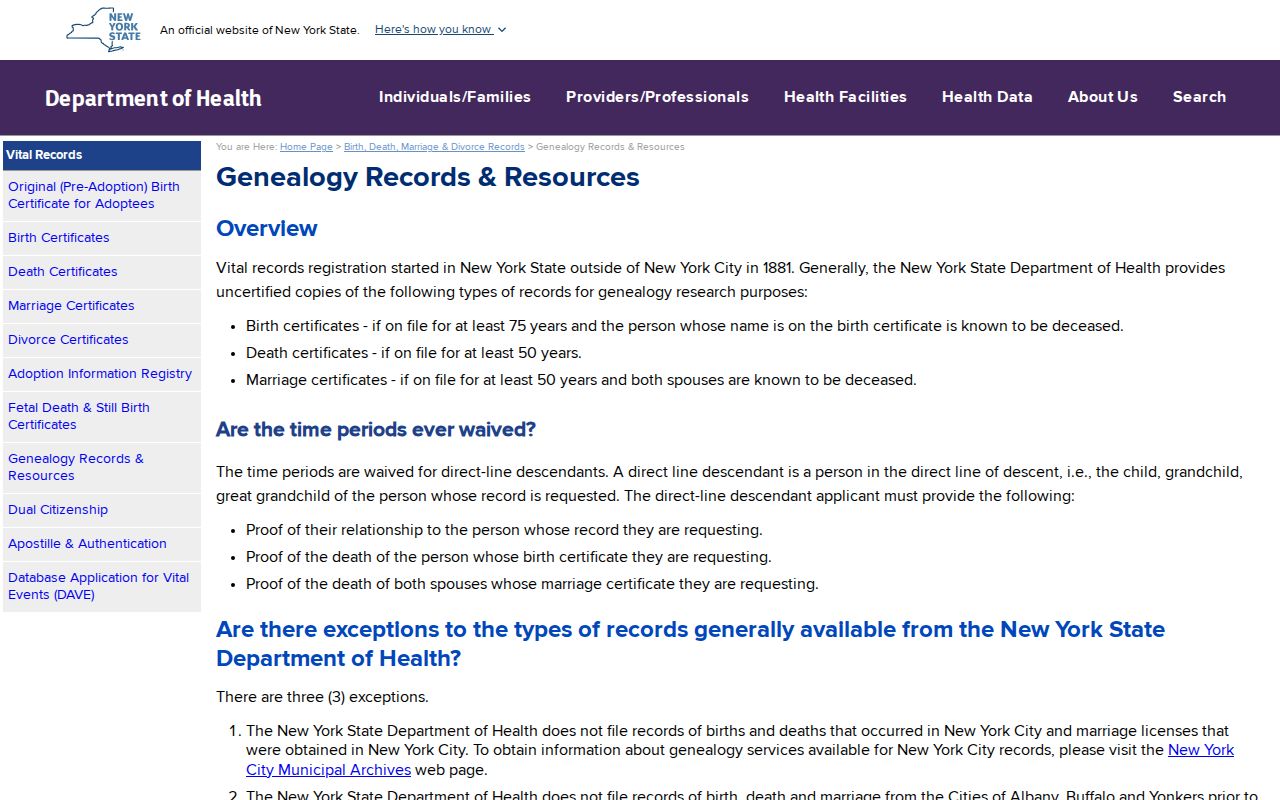
The official instructions keep the historical index route separate from a request for a certified certificate.
Lynbrook FOIL Request Channels
Use a records request when the needed material has no searchable portal. The Village Clerk is custodian of village archives, minutes, notices, elections materials, and FOIL requests. The Building Department can route a defined address request for permits, inspections, certificates, plans, or dispositions. Nassau County has its own custodians for Clerk, assessment, and Board of Elections records. Name the series, dates, address or SBL, and any case or index number so staff can locate the right file.
Nassau’s Board of Elections FOIL page shows the county request route and its office details.
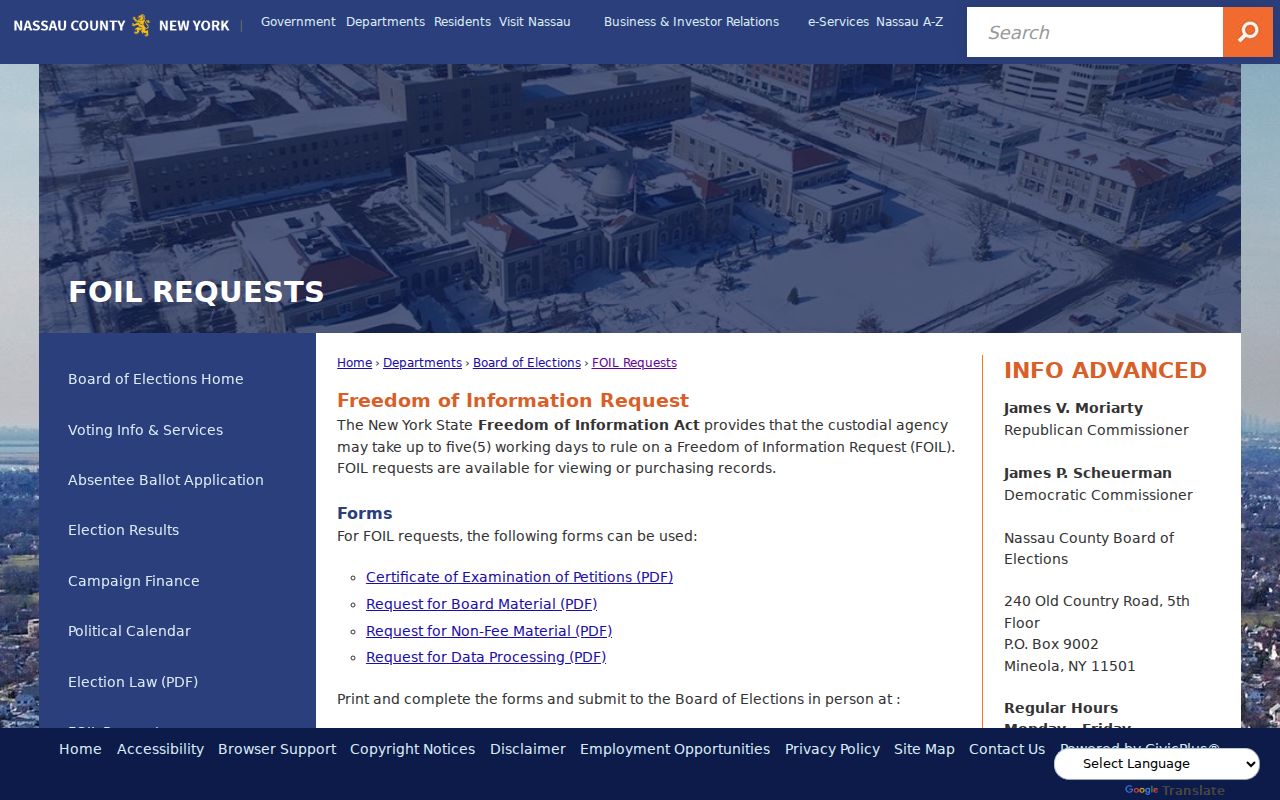
The request path is useful when an elections record is not available through the individualized voter-status form.
Under Public Officers Law § 89(3)(a), an agency must grant, deny, or acknowledge a FOIL request within five business days and provide an approximate later date when necessary. A precise request is more useful than a broad request for information about a person.
Historical Lynbrook Resident Directories
The strongest verified printed-directory source is the New York State Library’s Lynbrook City Directory for 1928/29. It is on microfilm in the seventh-floor Microforms Area, is non-circulating, and is available onsite. The research did not verify a continuous printed Lynbrook run, a publisher, or a public entry image beyond that confirmed reel. That gap matters. A directory year can place a person, household, or business at a recorded address, but it should not be stretched into a claim about an entire decade.
Lynbrook Public Library also points researchers to local history, New York Heritage, historic newspapers, and New York telephone directories. The Historical Society of East Rockaway & Lynbrook links family records, newspapers, maps, cemetery context, FamilySearch, and the county property viewer. For the full directory shelf and entry-reading process, use the Lynbrook city directories.
Lynbrook Library Names and Memory
Local collections often supply the people context that a parcel or court index lacks. Lynbrook Public Library’s history resources include Local History of Lynbrook, NY Heritage, New York City Telephone Directories, New York Times Historical, Newsday Historical, and local-history links. The library’s New York Heritage material includes photographs, audio, the Leo H. Bock Collection, movie-theatre programs from 1932 to 1937, the Audrey Wood Collection, scrapbooks, brochures, and Camera Club material. A caption, donor note, program, or newspaper notice can support family-history research without pretending to be a complete resident roll.
Lynbrook Public Library’s history page is the starting link for these local collections.
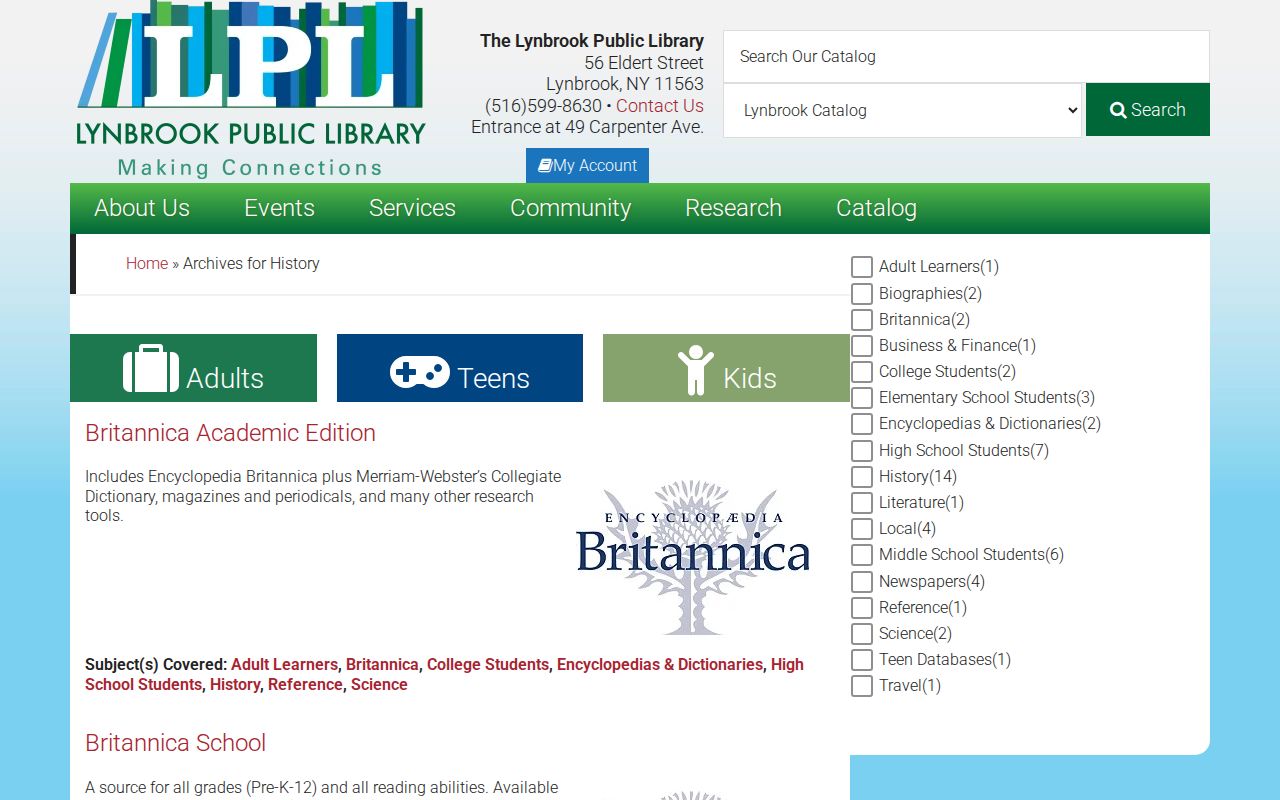
Its collection links provide a distinct historical layer after an address or name has been checked in county records.
Pearsalls Names in Lynbrook Records
Older records can use Bloomfield, Pearsall’s Corners, Pearsalls, or Lynbrook. The 1894 choice of Lynbrook rearranged the name Brooklyn, and the village incorporated in 1911. Search those variants in newspaper databases, historic maps, deeds, directories, and family sources when a modern-place search comes up empty. The 1919 Library of Congress Sanborn volume has nine Lynbrook and East Rockaway sheets, while 1906 and 1914 maps and Nassau’s 1926 and 1950 layers can help connect an older lot or road label to a modern parcel.
The village’s compact geography makes parcel-map browsing practical, but it also raises the chance of same-name and same-street collisions. Preserve the historic label alongside the modern SBL or address rather than silently changing it.
Note: A map can establish the historical setting of a parcel, but the legal description and recorded document remain the stronger ownership keys.
Lynbrook Privacy and Safe Record Use
Public inspection and broad republishing are different things. Keep a research log with a source URL, custodian, result date, search terms, and a stable key such as SBL, case number, or archive call number. Avoid copying full dates of birth, financial details, protected addresses, or unrelated family data. If a record needs correction, contact the office that created it, such as Assessment, the County Clerk, the Board of Elections, a court clerk, or the registrar.
Beware of deed-copy and property-transfer mail solicitations. Nassau says the Clerk is the official source for certified copies, and its Property Fraud Alert is a free email notification channel for filings against a selected name or property description. A portal result should always be verified with the custodian before it is relied upon.
Lynbrook Records Scanning Transition
Lynbrook’s record trail is changing, but digitization does not mean a complete online name search exists. A January 2025 village board packet proposed a Laserfiche upgrade and scanning roughly 246,000 Police Department arrest records from 1985 through 2018, supported in part by a State Archives grant. The 2024–25 State Archives award list also identifies Lynbrook inactive-records funding. Later 2025 minutes approved a records disposition action under the LGS-01 retention schedule.
For historical local police material, make a narrow request by record series, date, and case number and ask whether a file was retained, scanned, redacted, or legally disposed. No public Lynbrook incident or person-search portal was located. That careful fallback is more accurate than assuming a scan project created an unrestricted directory.